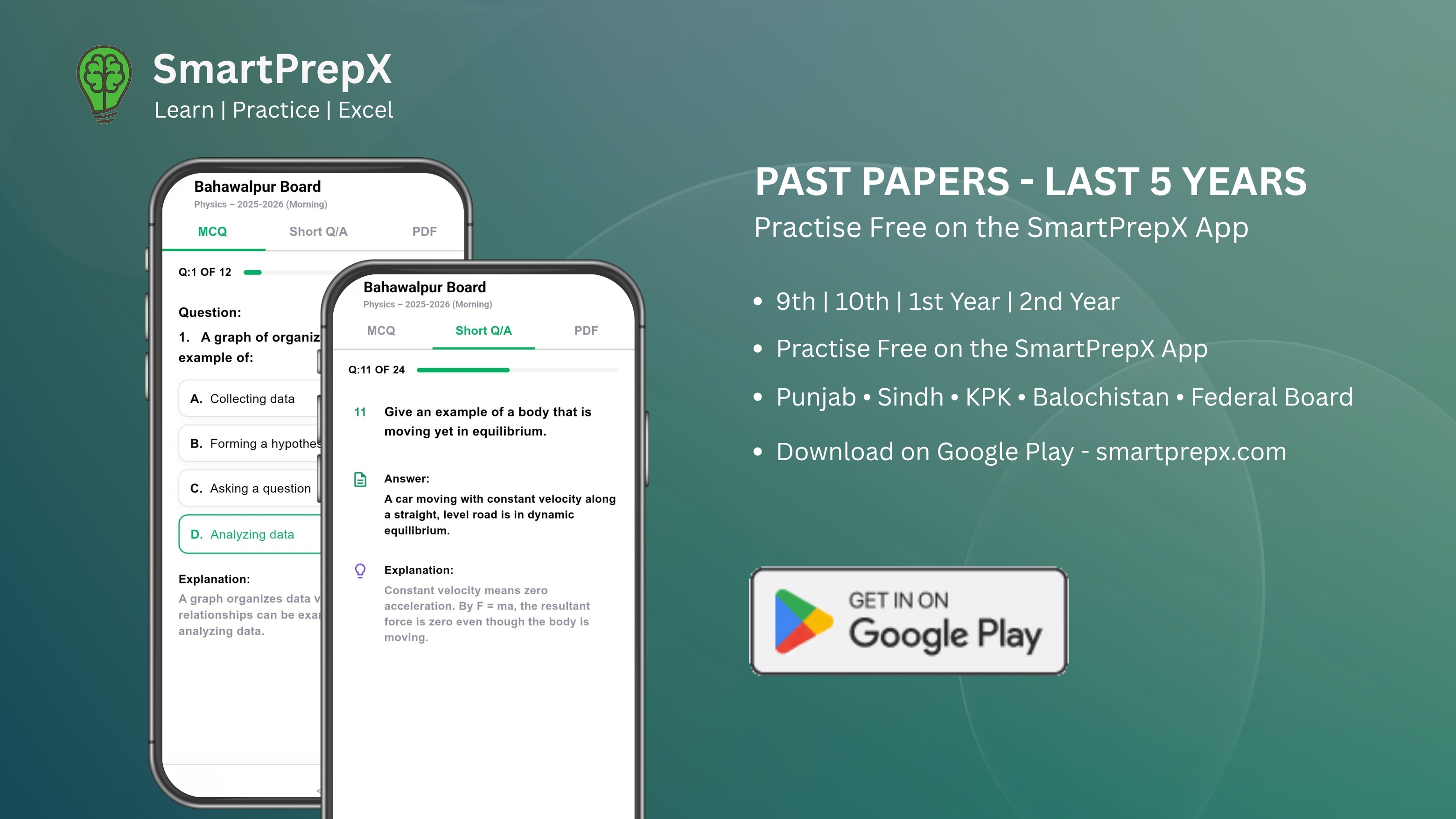
If you ask any topper in Pakistan how they prepared for the board exam, the answer is almost always the same: they solved past papers. Board papers repeat concepts, question styles and even exact questions across years, so the fastest way to understand what your board expects is to practise the last five years of papers. This guide explains how to use past papers of the last 5 years for 9th class, 10th class, 1st year and 2nd year, for Punjab, Sindh, KPK, Balochistan and the Federal Board (Islamabad), and how SmartPrepX helps you practise them on your phone.
Why the Last 5 Years of Past Papers Matter
Why five years? One or two papers are too few to show a pattern, while papers older than five years may no longer match the current scheme of studies. Five years is long enough to see what repeats and recent enough to stay relevant. Students who work through them usually gain these advantages:
- Know the paper pattern. You see how many MCQs, short questions and long questions come, how marks are divided and how much time each section needs.
- Spot repeated topics. Important definitions, derivations, numericals, essays and letters often return in the same or a slightly changed form.
- Learn how boards word questions. A question can look new but test an old idea. Past papers train you to recognise it.
- Build speed and confidence. Solving a paper in the real time limit removes exam fear and improves your writing speed.
- Find weak chapters early. Wrong answers show exactly which chapters need more revision.
Past papers do not replace the textbook. Read the chapter first, practise questions next and use past papers to test whether you are exam-ready.
Past Papers for All Classes: 9th, 10th, 1st Year and 2nd Year
Pakistan's board system has four exam levels. Each has its own past papers.
- 9th class (SSC Part-I): your first board exam. Papers help you understand the board style early, so 10th class feels familiar.
- 10th class (SSC Part-II) / Matric: the paper that decides your Matric result and college admission. Focus on the last five annual papers.
- 1st year (HSSC Part-I) / 11th class: a heavier syllabus with new concepts. Past papers help you choose what to prioritise.
- 2nd year (HSSC Part-II) / 12th class: your final Intermediate paper and your gateway to MDCAT, ECAT and university merit. Solve as many papers as possible.
Students of Pre-Medical, Pre-Engineering, ICS, Commerce, Arts and General Science groups should solve papers of their own subjects. Every group has different subject combinations and paper schemes.
Past Papers by Province and Board
Pakistan has no single board. Every province has several boards, and the Federal Board works separately in Islamabad. Syllabus, textbooks and paper schemes can differ, so always practise papers of your own board.
Punjab Board Past Papers
Punjab has the largest number of students and nine boards: Lahore, Rawalpindi, Gujranwala, Faisalabad, Multan, Sargodha, Bahawalpur, D.G. Khan and Sahiwal. Boards in the province follow the Punjab Curriculum and Textbook Board books, but each board sets its own papers, so the question selection differs. If you are searching for Lahore board past papers or Rawalpindi board past papers, solve your own board first and then try neighbouring boards for extra practice. You can also check your scheme on the official BISE Lahore website.
Sindh Board Past Papers
Sindh students appear under the Karachi, Hyderabad, Larkana, Mirpurkhas, Sukkur and Shaheed Benazirabad boards. Karachi has separate boards for Matric and Intermediate. Many Sindh students prepare in both English and Urdu or Sindhi medium, so pay attention to the language and paper pattern of your own board. For official notices and syllabus, see BSEK Karachi.
KPK Board Past Papers
Khyber Pakhtunkhwa has eight boards: Peshawar, Abbottabad, Bannu, D.I. Khan, Kohat, Malakand, Mardan and Swat. Students often search for Peshawar board past papers or Mardan board past papers. The official BISE Peshawar site is a good place to confirm the current scheme of studies. Since question styles vary slightly between KP boards, practising your own board's last five papers gives the best preparation.
Balochistan Board Past Papers
Students in Balochistan appear under the Balochistan Board of Intermediate and Secondary Education (BBISE), Quetta. Because there is one main board for the province, students can get a very clear picture of the paper pattern by solving all five years in order. Start with the oldest paper and move to the latest to see how the board's style has developed.
Federal Board (FBISE) Islamabad Past Papers
The Federal Board of Intermediate and Secondary Education (FBISE) conducts exams for schools and colleges in Islamabad and for many institutions connected to the federal system. Its papers follow the national curriculum, and students often search for FBISE past papers or Federal Board past papers 9th, 10th, 11th and 12th class. Read official updates and notifications on the FBISE website.
How to Solve Last 5 Years of Past Papers: A Step-by-Step Plan
Do not just read the papers. Solve them like a real exam. This simple routine works for students of every board.
- Finish the syllabus portion first. Complete at least a few chapters before attempting a paper, then increase the coverage with time.
- Start with the oldest of the five years. Move towards the latest paper so the newest pattern is fresh in your mind before the exam.
- Set a timer. Attempt the MCQs, short questions and long questions in the actual time limit.
- Check your answers honestly. Mark each paper using the official marking scheme or textbook, not by guessing.
- Note every mistake. Write the chapter name next to each wrong or skipped question.
- Revise the weak chapters. Go back to the textbook, then solve similar questions again.
- Make a repeated-questions list. Questions that appear in two or more years deserve extra revision.
- Repeat weekly. One full paper per week in the final two months is a strong target for most students.
Past Papers by Section: What to Focus On
Most board papers have an objective part and a subjective part. Each needs its own approach.
- MCQs: these carry quick marks. Practise them until you can finish the objective section well before time. Our guide on online MCQs test preparation in Pakistan explains this in detail.
- Short questions: keep answers brief and accurate, usually two or three lines or as the question demands. See our article on online short questions and answers preparation for practical tips.
- Long questions: structure matters. Use headings, definitions, diagrams, equations and a clear conclusion. Examiners reward neat, organised answers.
Subject-Wise Tips for Using Past Papers
- Physics, Chemistry and Mathematics: past papers show which numericals, derivations and formulas are asked most. Practise them on paper, not just in your head.
- Biology: pay attention to labelled diagrams and definitions. They are frequent and easy to score.
- English: practise comprehension, grammar, letters, applications and essays from previous papers to improve both speed and accuracy.
- Urdu, Islamiat and Pakistan Studies: these subjects reward consistent revision. Past papers show how the board frames its questions and which lessons come up often.
- Computer Science and other optional subjects: past papers show how theory and practical-based questions are balanced.
Common Mistakes Students Make With Past Papers
- Only reading the paper. Solving it under time pressure teaches far more.
- Practising only the latest paper. Patterns appear across years, so use all five.
- Ignoring your own board. A Karachi paper and a Lahore paper are not identical. Start with your own board.
- Memorising answers without understanding. Boards change wording, so concepts matter more than cramming.
- Starting too late. Begin early and increase the number of papers as the exam approaches.
- Using unreliable guess papers. Trust real past papers and organised, chapter-wise material.
Practise Past Papers With SmartPrepX
Collecting past papers from different websites, photocopies and groups wastes valuable study time. SmartPrepX brings board exam preparation into one mobile app built for Matric and Intermediate students across Punjab, Sindh, KPK, Balochistan and the Federal Board. You choose your class, province and board, and you can practise with:
- Past papers to understand board patterns and repeated topics.
- Chapter-wise MCQs and short questions to strengthen concepts before you attempt a full paper.
- Subject tests and mock tests to build speed and exam stamina.
- Performance reports that point out your weak chapters.
- An AI tutor that explains difficult topics in English and Urdu.
The set of papers and years available can differ by class and board, and content is updated over time, so please check the app for the papers currently available for you. If you are new, read why students choose SmartPrepX or compare options in our guide to the best study app for Matric and F.Sc students in Pakistan.
Get started today: download the SmartPrepX app from Google Play or visit the Get App page.
A Simple 30-Day Past Paper Plan
If your exam is a month away, this plan keeps you focused:
- Days 1 to 10: revise weak chapters and solve chapter-wise MCQs and short questions.
- Days 11 to 20: solve one older board paper every two days, then review mistakes the same day.
- Days 21 to 27: solve the two most recent papers in full exam conditions and compare scores.
- Days 28 to 30: revise your repeated-questions list, formulas, definitions and diagrams. Sleep well before the exam.
Adjust the plan for each subject. Heavy subjects like Physics, Chemistry and Mathematics may need more paper-solving days than lighter ones.
Frequently Asked Questions
Where can I find the last 5 years of past papers for my board?
Official board websites publish notices and sometimes papers, and SmartPrepX lets you practise board-style papers inside the app. Select your province, board and class to see what is available for you.
Are past papers enough to pass the board exam?
Past papers are one of the best tools, but they work best alongside the textbook, chapter-wise practice and regular revision.
Do papers of one board help students of another?
Yes, partly. Concepts overlap, especially under the same curriculum, but question selection and style can differ. Start with your own board and use others for extra practice.
How many past papers should I solve before the exam?
Try to solve all five years of your own board for every major subject. If time is limited, prioritise the latest three years and your weakest subjects.
Can I practise past papers on my phone?
Yes. SmartPrepX is a mobile app, so you can practise from home, at the academy or while travelling. For more answers, visit the FAQ page or contact the team.
Is SmartPrepX free?
SmartPrepX offers a free plan to get started and a Premium plan for broader access. Features and prices can change, so check the Plans screen inside the app for the latest details.
Final Thoughts
Board exams reward students who understand the paper, not only the syllabus. By solving the last five years of past papers for your own board, whether in Punjab, Sindh, KPK, Balochistan or the Federal Board, you learn what examiners ask, how marks are divided and where you need to improve. Combine that with chapter-wise practice and steady revision, and you give yourself a real advantage.
Ready to begin? Download SmartPrepX from Google Play, learn more about us, or browse more study guides in our articles section.